Ultramarine
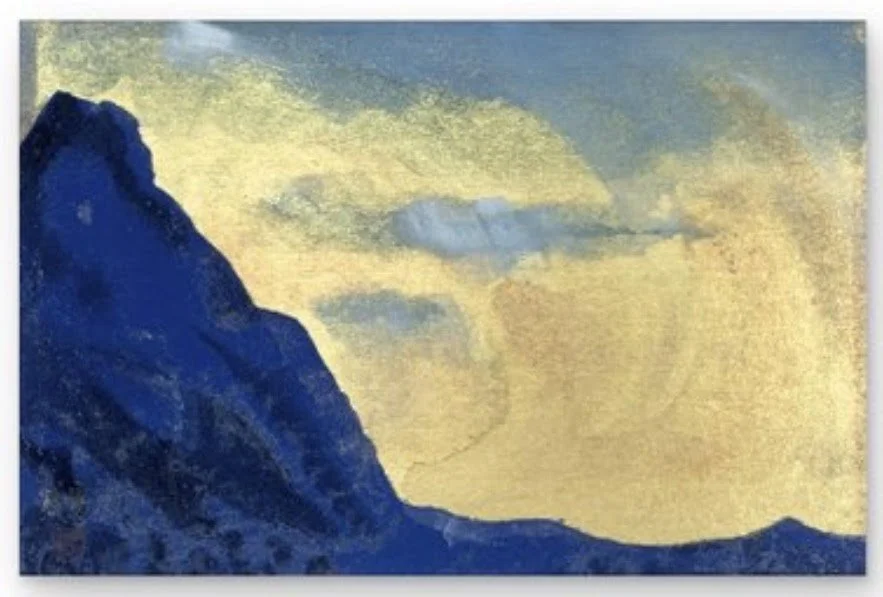
From my personal collection.
A small Japanese painting whose restrained dialogue between ultramarine and muted gold continues to inspire my own exploration of colour.
Some colours simply describe the world.
Others seem to contain one.
Ultramarine belongs to the latter.
Its name comes from the Latin ultramarinus — "from beyond the sea." For centuries, the pigment travelled from the lapis lazuli mines of Badakhshan, in present-day Afghanistan, across trade routes to Europe. Long before it reached an artist's palette, it had already completed an extraordinary journey.
Because of its rarity, natural ultramarine became one of the most valuable pigments in the history of painting. Renaissance artists often reserved it for the most significant passages of a work: the robe of the Virgin Mary, the heavens, or moments of divine light. It was not merely blue. It became a symbol of value, transcendence and presence.
What continues to fascinate me is not only its history but its character.
Ultramarine is never flat.
It carries a subtle warmth, a hidden red that gives the colour an inner vibration. In watercolour, especially in its granulating forms, it settles into the paper with a life of its own. Pigment separates, gathers and leaves behind textures that cannot be fully controlled.
That unpredictability is precisely what makes it so compelling.
Perhaps every artist eventually discovers a colour that feels less like a material and more like a language.
For me, ultramarine has become one of those languages.