Conversation No.:01 — Wie man dem toten Hasen die Bilder erklärt
Explaining Pictures to a Dead Hare
Some conversations begin where language ends.
In 1965, Joseph Beuys performed one of the most influential works of twentieth-century art: How to Explain Pictures to a Dead Hare. His gallery remained closed to the public while he walked through the exhibition, carrying a dead hare in his arms and whispering to it as if it could understand the paintings better than the visitors waiting outside.
The performance was never really about the hare.
It asked a deeper question: Can art ever be explained?
Or does every attempt at explanation only move us further away from the experience itself?
The hare has long occupied a special place in mythology and art. It represents fertility, transformation, vulnerability, and instinctive knowledge. A creature that does not analyse the world, yet somehow seems deeply connected to it.
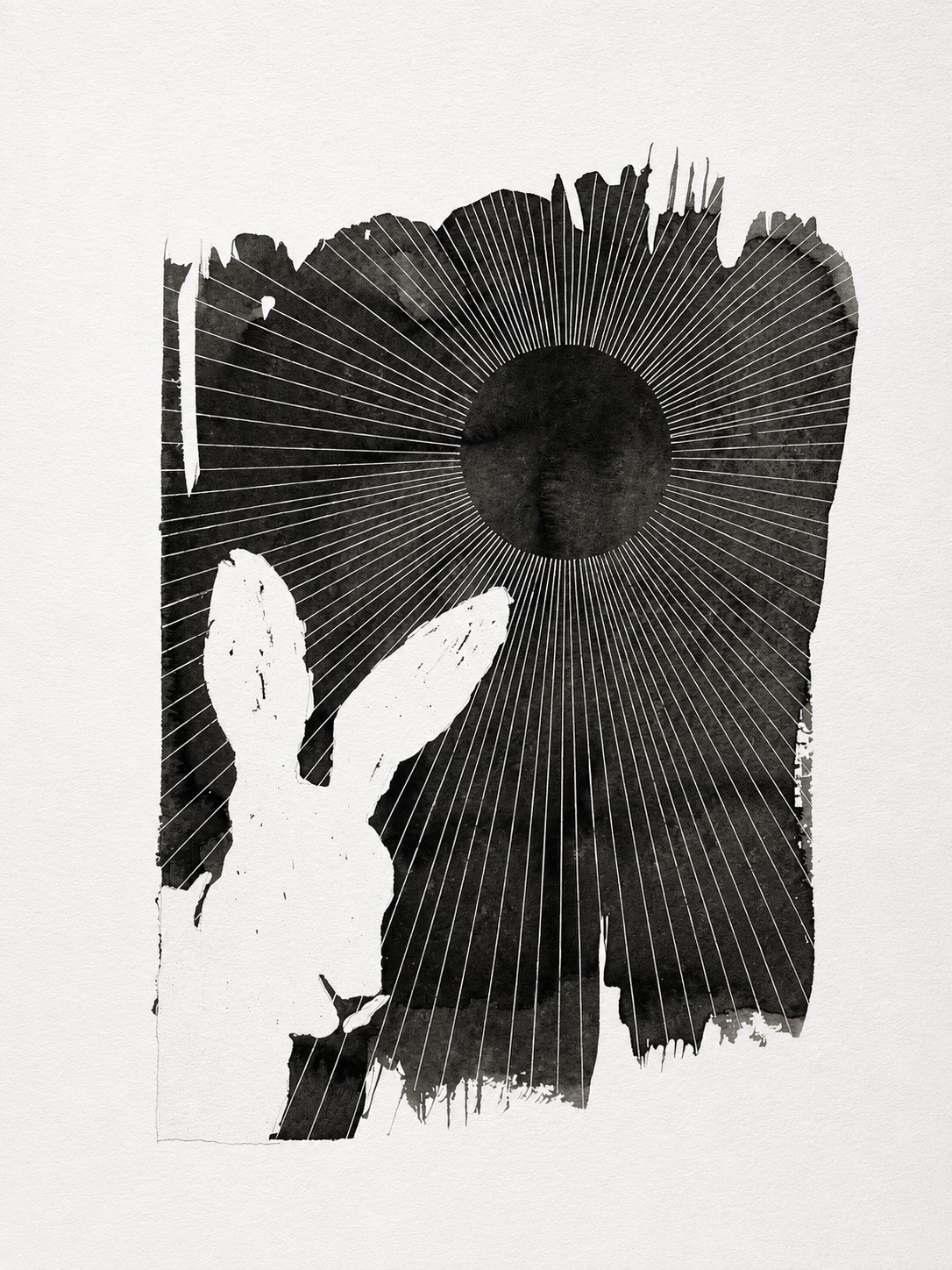
This watercolor was created for Balázs Mesterházy's verse novel The Moldy God. While painting it, I found myself returning to Beuys' performance—not to illustrate it, but to continue its conversation.
The black circle radiates outward like a silent sun, while the white silhouette of the hare remains untouched by the darkness surrounding it. The image becomes less a narrative than a field of attention, where absence speaks as clearly as presence.
Perhaps the most meaningful conversations in art are the ones that happen without words.
A painting does not ask to be understood immediately.
It asks us to remain with it long enough for recognition to arrive on its own.
Sometimes the artwork is not waiting for an explanation.
It is waiting for a listener.
Artwork
Conversation #10 — Explaining Pictures to a Dead Hare
ink on paper
Created for Balázs Mesterházy's verse novel Penészes Isten (The Moldy God).